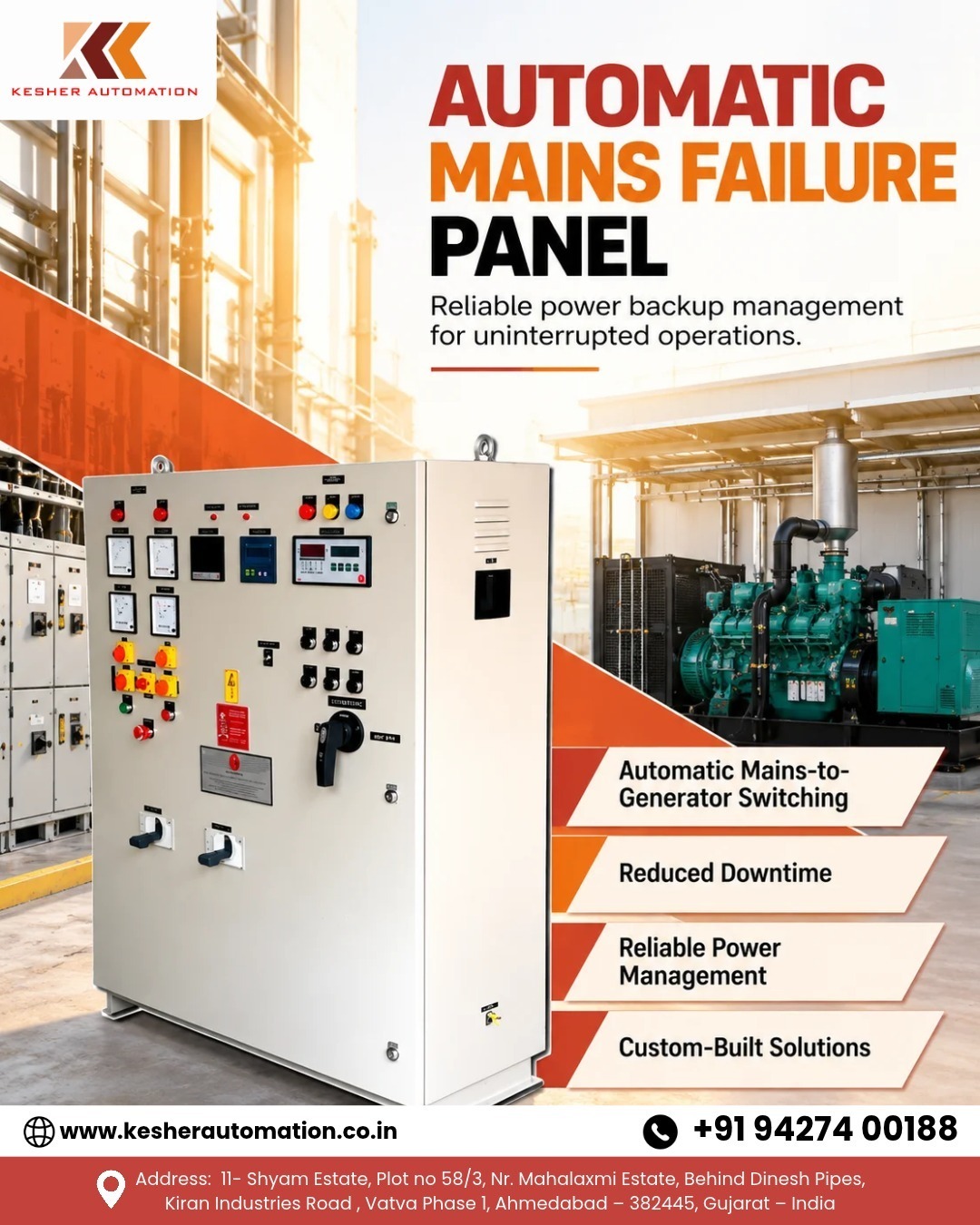
Unexpected power failures can interrupt industrial production, affect essential equipment, and disrupt daily business activities. For facilities that rely on a stable electricity supply, an automatic backup system can help reduce these interruptions. An Automatic Mains Failure (AMF) Panel monitors the incoming mains supply and coordinates switching between utility power and a standby generator when needed.
Kesher Automation provides electrical automation and control solutions for industrial and commercial applications. A properly configured AMF panel helps manage generator operation, reduces the need for manual switching, and supports a more reliable backup power arrangement.
What Is an Automatic Mains Failure (AMF) Panel
An Automatic Mains Failure (AMF) Panel is an electrical control panel that detects mains power failure and initiates the programmed standby generator sequence. It monitors selected electrical parameters and responds when the incoming supply fails or moves outside configured limits.
After the generator starts and reaches the required operating conditions, the panel's transfer equipment connects the load to generator power. When the mains supply returns and stabilizes, the system can transfer the load back to utility power and stop the generator according to its programmed sequence.
This automation helps businesses manage power changes without requiring an operator to carry out every switching step manually.
How Does an AMF Panel Work During a Power Outage
An automatic mains failure system generally follows four stages:
1. Monitoring the Mains Supply
The controller continuously checks configured parameters, such as voltage and phase conditions, to identify a supply failure or abnormality.
2. Starting the Standby Generator
When a qualifying power failure occurs, the panel sends a start signal to the compatible generator, provided the system is in automatic mode and no blocking fault is present.
3. Transferring the Electrical Load
Once the generator reaches the required voltage and frequency, the transfer mechanism switches the connected load to the backup supply.
4. Restoring Mains Power
When utility power returns and remains stable for the programmed period, the panel transfers the load back to the mains. The generator may then complete a cooling period before shutting down.
The exact sequence depends on the controller, transfer arrangement, generator, and installation design.
Key Benefits of an Automatic Mains Failure Control Panel
Installing an Automatic Mains Failure (AMF) Panel can offer several practical advantages:
* Reduced downtime: Helps minimize interruptions caused by mains supply failures.
* Automatic generator operation: Reduces dependence on manual starting and changeover.
* Reliable power management: Coordinates generator starting and load transfer.
* Operational convenience: Allows personnel to focus on other tasks during a power outage.
* Improved monitoring: Suitable configurations can provide status indications, alarms, and fault information.
* Better backup planning: Supports continuity for selected loads when the generator and electrical system are correctly sized.
An AMF panel cannot eliminate every interruption. Generator starting time, equipment condition, and load requirements influence the level of continuity achieved.
Where Are AMF Panels Commonly Used
An Automatic Mains Failure Control Panel can be suitable for facilities that use standby generators, including:
* Manufacturing plants: Supporting essential production equipment.
* Commercial buildings: Managing backup power during utility failures.
* Healthcare facilities: Supporting designated electrical loads where appropriate backup arrangements are installed.
* Warehouses: Maintaining power for selected operational systems.
* Data centers: Working as part of a broader backup power arrangement.
* Industrial facilities: Coordinating utility and generator power sources.
For equipment that cannot tolerate even a brief interruption, a suitably designed uninterruptible power supply (UPS) may also be necessary.
How to Choose the Right AMF Panel for Your Facility
When choosing an AMF panel, consider the generator’s rated capacity, total connected load, operating voltage, phase arrangement, automation needs, and compatibility with the transfer switching system to ensure reliable performance. Check compatibility with the generator's starting system and the facility's electrical distribution arrangement.
Also consider safety interlocks, overload and fault protection, operating modes, maintenance access, and technical support. A qualified electrical professional should verify the design and ensure that the installation meets applicable requirements.
Businesses searching for an Automatic Mains Failure (AMF) Panel Manufacturer in Ahmedabad should compare technical specifications and confirm the manufacturer's capabilities. Buyers looking for an Automatic Mains Failure (AMF) Panel Supplier in Gujarat should also evaluate product suitability, installation support, and after-sales service. For broader procurement, assess an Automatic Mains Failure (AMF) Panel Distributor in India based on product availability and technical support.
Kesher Automation can discuss your electrical control requirements and help you identify a suitable panel configuration.
Frequently Asked Questions
1. What is the main function of an AMF panel?
An AMF panel detects mains supply failure and coordinates standby generator starting and load transfer according to its programmed settings.
2. Does an AMF panel start the generator automatically?
Yes. When configured correctly and operating in automatic mode, it can send a generator-start signal after detecting a qualifying mains failure.
3. What is the difference between an AMF panel and an ATS panel?
An AMF panel typically monitors mains power and coordinates generator operation and switching. An automatic transfer switch (ATS) primarily transfers the load between available power sources. Some systems combine both functions.
Keywords